
Fleet Safety and Costs in Construction
The construction industry has historically treated fleet safety and cost management as separate functions. Safety sits with the HSE lead; costs sit with the transport manager or finance team. The two rarely talk to each other in a structured way.
This is a missed opportunity. The data consistently shows that fleets with stronger safety records have lower total fleet operating costs. The relationship isn't coincidental: it reflects the same underlying operational quality.
How Safety Improvements Drive Cost Reductions
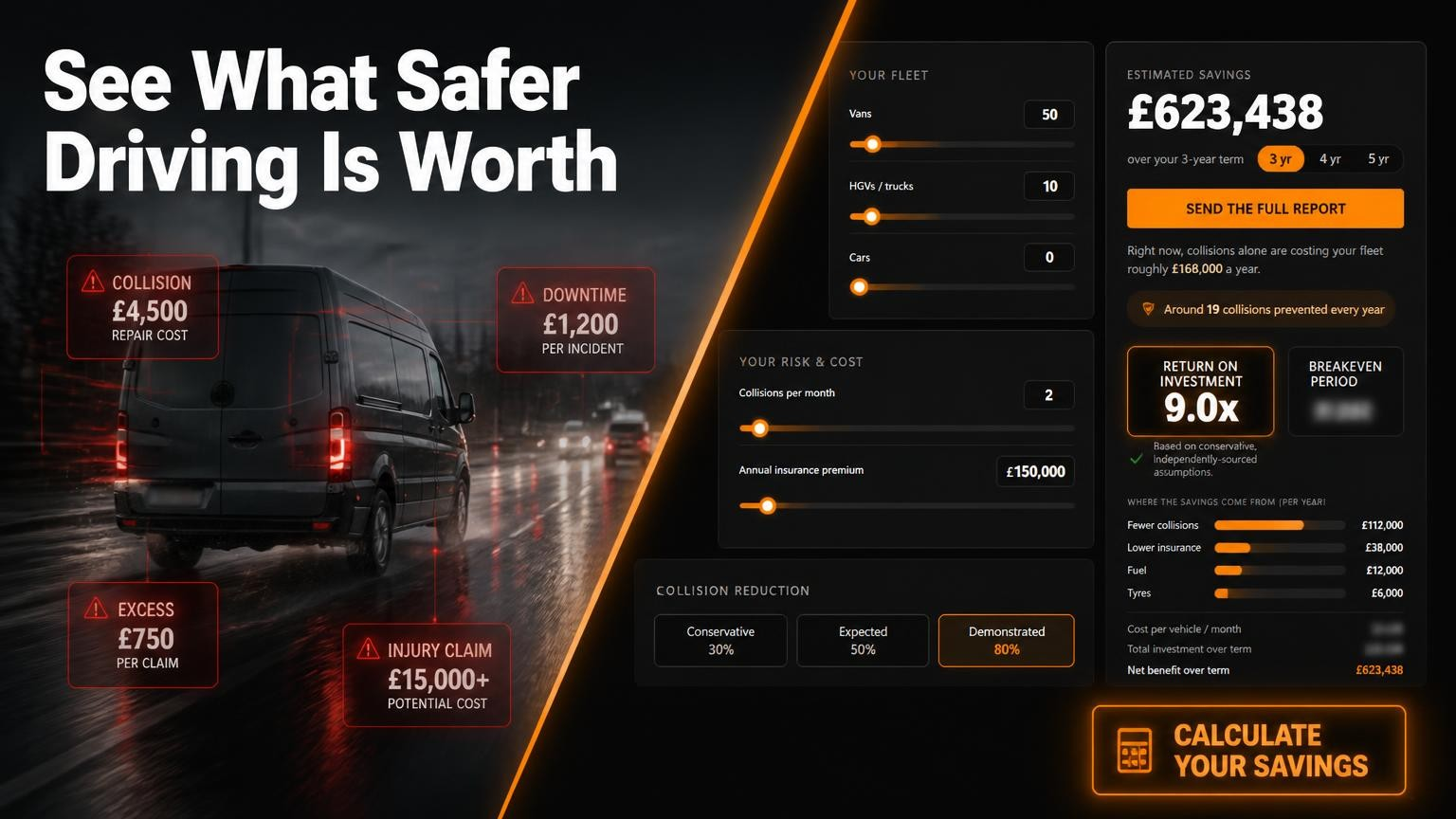
Accident reduction directly lowers insurance claims costs, and over time drives down premium rates. A fleet that can demonstrate a sustained reduction in at-fault incidents is in a fundamentally stronger position at insurance renewal than one that cannot.
Reduced incidents also mean lower vehicle downtime. Accident damage repair takes vehicles off the road. Fewer incidents mean higher fleet availability and lower disruption to project programmes.
Driver behaviour improvements that reduce accident risk also reduce fuel consumption, tyre wear, and brake wear. The driving patterns associated with higher accident risk (harsh braking, rapid acceleration, excessive speed) are also the patterns that generate the highest per-mile running costs.
Making the Business Case
Fleet safety investment is most effectively framed as a financial return rather than a compliance cost. The question is not what does this safety system cost? but what is the expected reduction in claims, downtime, and maintenance costs, and how does that compare to the system cost?
Fleets that have made this calculation explicitly almost always find the investment case straightforward. The challenge is usually getting the data to make the calculation in the first place.
Want to see this on your own fleet? Talk to our team.
We can show you how Exeros helps reduce road risk and operational cost across your vehicles.

Table of contents
Related insights

Stay alert and informed
UK regulatory updates, fleet efficiency case studies and safety insights, sent to your inbox.
Talk to the teamRead more from Exeros

Talk to our team about your fleet's specific challenges and how we solve them.