
What Is a Bridge Strike? Definitions, Causes and Costs
A bridge strike is when a vehicle, or the load it carries, hits a bridge. In the UK the term usually means a lorry, bus or van colliding with a low railway bridge. Network Rail recorded 1,666 bridge strikes in 2024/25.
That is roughly one every five hours. Most are avoidable, and almost all start with the same mistake: a driver who does not know, or does not check, the height of their vehicle against the bridge ahead. This guide explains what counts as a bridge strike, why they happen, what they cost operators and drivers, and how fleets reduce the risk.
Bridge strike meaning: what counts as a bridge strike?
Network Rail defines a bridge strike as a motor vehicle crashing into a bridge where the railway crosses over a road, or where a road crosses over the railway. That gives two types:
- Rail over road (underbridge strikes). A vehicle that is too tall hits the underside of a railway bridge spanning the road. This is the most common type and the one most associated with HGVs, double-deck buses and high-sided vans.
- Road over rail (parapet strikes). A vehicle on a road bridge leaves the carriageway and hits the bridge parapet or barriers above the railway. These are rarer but can put debris or a vehicle onto the line.
The wider term bridge collision also covers strikes on road bridges and footbridges managed by highway authorities such as National Highways and local councils. Whatever the owner, the trigger is the same: the vehicle, its load or raised equipment (a tipper body, crane arm or skip loader) is taller than the clearance available.
A strike does not need to cause visible damage to count. Any contact should be reported straight away, using the phone number and bridge identification number shown on the structure, because the bridge has to be examined before trains can run over it at normal speed.
How common are bridge strikes in the UK?
Bridge strikes on the railway have held between roughly 1,500 and 1,900 a year for the past five years, with no sustained fall.

Network Rail says that on an average day, drivers of at least five HGVs or buses hit a railway bridge. Some bridges are struck again and again: in 2024/25 the most struck was Watling Street (A5) in Hinckley, hit 22 times, followed by Harlaxton Road in Grantham, hit 18 times (Network Rail).
These figures cover railway bridges only. Strikes on road bridges and footbridges add to the total, and near misses go largely unrecorded.
What causes HGV bridge strikes?
Most HGV bridge strikes come down to a driver not knowing their vehicle's height, or not checking it against the route. Network Rail research found that 32% of drivers admitted setting off without knowing their vehicle height, and 56% did not consider low bridges when planning a journey (Network Rail). The common causes are:
- Unknown or wrong vehicle height. Drivers swap between vehicles, trailers and bodies of different heights. The height notice in the cab is missing, out of date or not checked.
- Car or general-purpose satnav. Consumer navigation apps do not route around low bridges. A driver following one can be sent under a bridge that a truck-specific system would have avoided.
- Diversions and unfamiliar routes. Roadworks, closures and new delivery addresses take drivers off routes they know.
- Loads and raised equipment. Plant on low loaders, containers, and tipper bodies, cranes or skip arms left raised add height the driver may not account for. National Highways reports that two-thirds of strikes on its bridges involve vehicles carrying loads on open trailers.
- Missed or ignored signs. Low bridge signs show the clearance in feet and inches and in metres. A driver who is distracted, fatigued or unsure of the height in one unit can misjudge it.
- Time pressure. Tight delivery windows push drivers to take a shortcut rather than turn back when a sign appears.

Want to see this on your own fleet? Talk to our team.
We can show you how Exeros helps reduce road risk and operational cost across your vehicles.
What does a bridge strike cost?
In 2024/25, bridge strikes cost the rail industry around £12m in delays and cancellations and caused 186,384 minutes of passenger delay, more than 120 days (Network Rail). That averages about £7,200 per strike in delay costs alone, before any repair. A single strike can cost far more: one hit on Harlaxton Road, Grantham, caused £423,000 of damage and 59 hours of passenger delay.
For a fleet operator, the bill rarely stops at the bridge.
- Infrastructure and delay costs. Network Rail and highway authorities recover repair, inspection and delay costs from the operator or its insurer.
- Vehicle and load damage. Roofs, bodies, trailers and cargo are often written off, and the vehicle is off the road during repair.
- Insurance. Claims raise premiums and excesses at renewal, and repeat incidents can affect cover.
- Operator licence. Traffic Commissioners can call operators to a public inquiry and curtail, suspend or revoke the O licence.
- Driver licence. Drivers can lose their vocational entitlement and face prosecution for careless or dangerous driving.
- Injury and reputation. Strikes can kill or seriously injure drivers, passengers and other road users, and damage customer confidence.
Traffic Commissioners treat bridge strikes as a failure of operator systems, not only driver error. In an April 2025 case, an operator's licence was curtailed by half after a strike, and the driver's vocational entitlement was suspended for two months. The Commissioner stated that effective control measures should prevent an incident from occurring.
How fleets prevent bridge strikes
Bridge strikes are preventable when operators control height, route and driver behaviour together. Network Rail's Wise Up, Size Up campaign asks drivers to know their vehicle height, plan their route, watch for low bridge signs and secure their load. Operators can build that into daily practice:
- Measure and display height. Record the travelling height of every vehicle, trailer and body combination. Vehicles over 3 metres must show their height in the cab, in feet and inches and in metres, and drivers should check it at every vehicle change.
- Use HGV-specific route planning. Give drivers truck navigation set to the correct vehicle profile, and plan routes and diversions before departure.
- Check raised equipment. Fit and test warnings for tipper bodies, cranes and skip arms, and make the check part of the walkaround.
- Train for height awareness. Cover bridge signs, unit conversion and what to do when a low bridge appears unexpectedly: stop, turn back, never chance it.
- Add in-cab warnings. A low-bridge collision prevention system compares the vehicle's set height with bridges on the road ahead and alerts the driver in time to choose another route.
- Review incidents and near misses. Video telematics gives transport managers evidence of what happened, supports coaching and shows Traffic Commissioners that controls are in place.
For more on putting these controls in place, read how to reduce bridge strikes.
How Exeros Helps Prevent Bridge Strikes
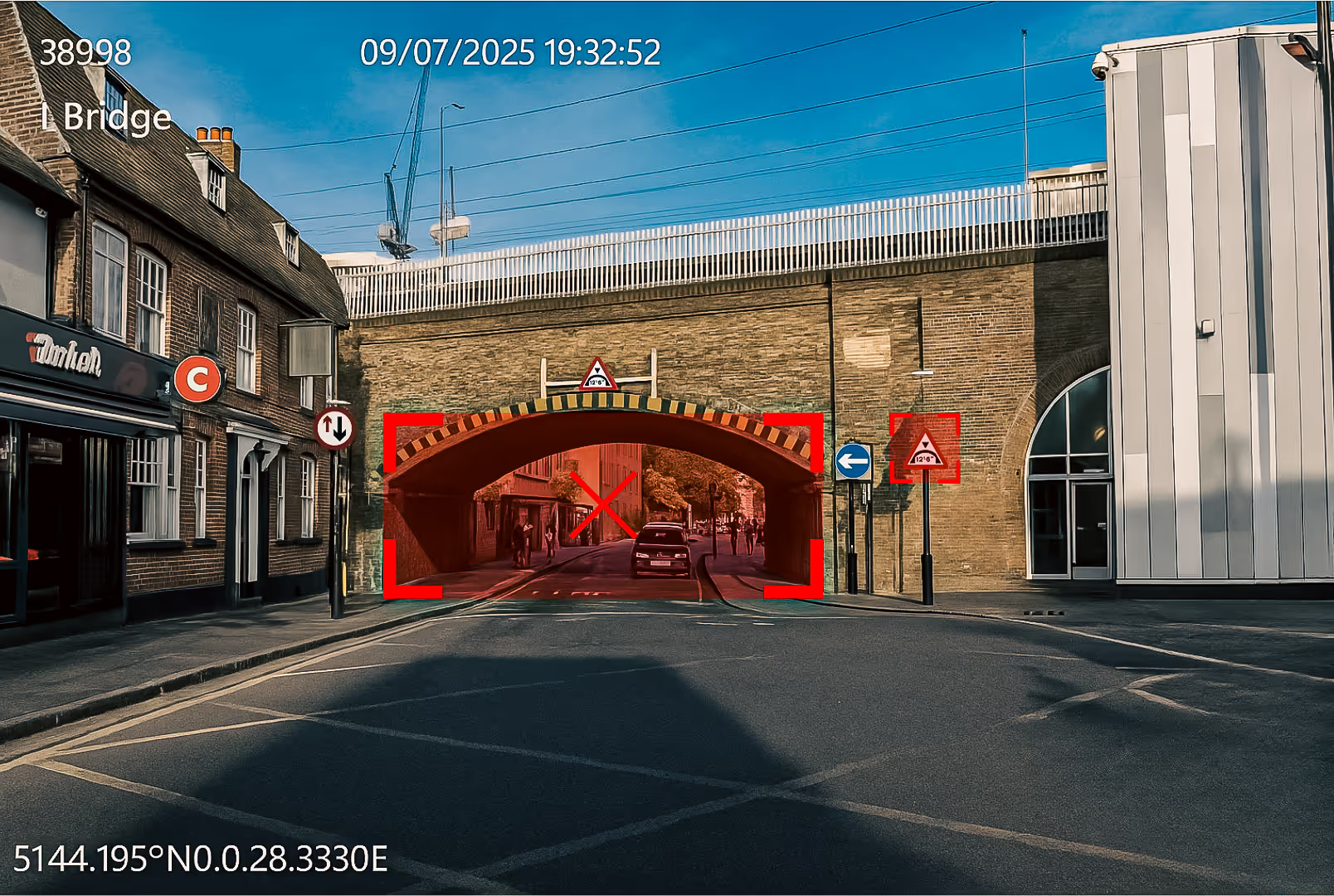
Exeros combines these controls in one system. Our low-bridge collision prevention system works alongside the Vidematics video telematics platform and AI fleet cameras, so height alerts, driver coaching and incident evidence sit in one place.
The system reads bridge height signs, cross-references them with GPS data and the vehicle's detected height, and alerts the driver in the cab. When an event happens, it records a short clip with the location and journey details, ready for review and coaching. Across Exeros-deployed UK fleets, customers have seen an 83% reduction in risk.

Frequently asked questions
What is a bridge strike?
A bridge strike is when a vehicle, or the load it carries, hits a bridge. In the UK it usually means a lorry, bus or van colliding with a low railway bridge over a road.
How many bridge strikes happen in the UK each year?
Network Rail recorded 1,666 bridge strikes between April 2024 and March 2025, about one every five hours. That was up 8.75% on the previous year.
Who pays for a bridge strike?
Network Rail and highway authorities recover repair, inspection and delay costs from the vehicle operator or its insurer. A single strike can cost hundreds of thousands of pounds.
Can a driver lose their licence for a bridge strike?
Yes. Traffic Commissioners can suspend or revoke a driver's vocational entitlement, and the operator's licence can be curtailed, suspended or revoked. Drivers can also be prosecuted for careless or dangerous driving.
What should a driver do after a bridge strike?
Stop safely and call Network Rail on the number shown on the bridge identification plate, quoting the bridge number. Call 999 if anyone is hurt or the road or railway is blocked, and report the incident to the police and your transport manager.
How can fleets prevent HGV bridge strikes?
Record and display every vehicle's height, use HGV-specific route planning, check raised equipment, train drivers on height awareness, and fit an in-cab low-bridge warning system.
Table of contents
Related insights

Stay alert and informed
UK regulatory updates, fleet efficiency case studies and safety insights, sent to your inbox.
Talk to the teamRead more from Exeros
Talk to our team about your fleet's specific challenges and how we solve them.