Fleet Management: A Safety Angle
Reducing Risk, Cutting Costs, and Building Safer UK Fleets
Getting everyone home safely.
Every. Single. Day.
What is inside
Contents
01Executive Summary
Fleet management in the UK is undergoing rapid transformation. What was once a discipline focused mainly on vehicles and logistics has expanded into a complex field shaped by regulation, cost pressures, sustainability targets, and workforce challenges.
Today's fleet managers are not only moving goods or people: they're balancing risk, compliance, technology, and culture in an environment that changes faster than ever before.
The pressures are mounting from all directions. Regulatory changes are accelerating, from London's stricter Direct Vision Standard requirements to the Zero Emission Vehicle mandate and new tachograph rules. At the same time, operators face rising fuel and insurance costs, while also addressing the industry's well-documented shortage of drivers. Add to this customer expectations around sustainability and road safety, and the role of the fleet manager becomes more complex and more strategic than at any point in the past.
Against this backdrop, the safety of fleets is no longer just a moral responsibility: it has become a decisive factor in operational resilience, financial performance, and reputation. Collisions and incidents create costs far beyond vehicle repairs: downtime, legal exposure, reputational harm, and lost contracts can sink margins in an already tight industry.
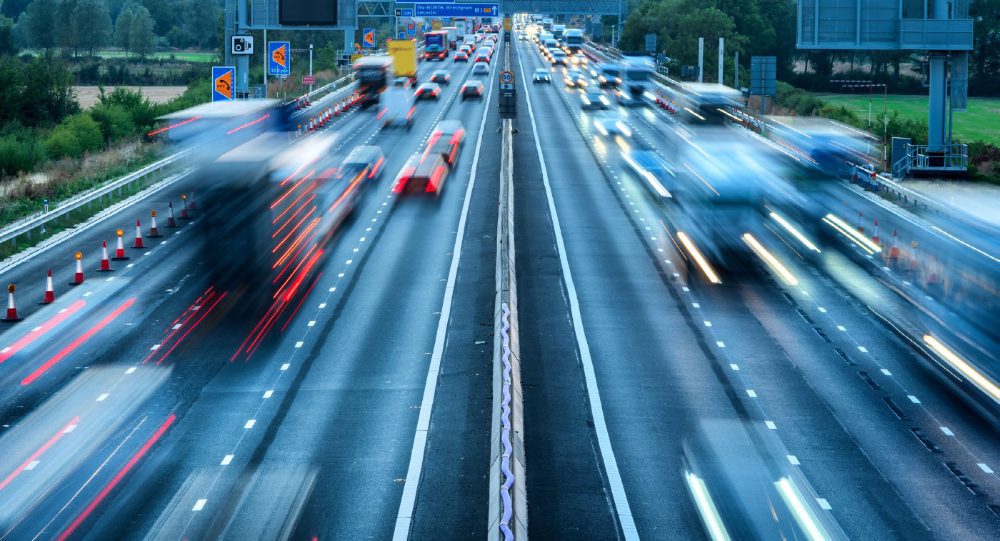
Technology plays a critical role, but it is not the only solution. Processes, policies, and above all, people remain central to building a safe and efficient fleet. What technology enables is visibility: it helps uncover the real risks fleets face, whether that is fatigue, distraction, tailgating, or blind spot collisions, and provides the data to act on them. Paired with strong leadership and a culture of safety, it becomes a powerful enabler of change.
This guide explores modern fleet management through the lens of safety. It highlights the hidden costs of incidents, examines the technologies and approaches that can mitigate risk, and considers the cultural and regulatory shifts that will shape the industry in the years ahead.
For UK fleets, the path forward is clear: safety is not a box to tick, but the foundation of long-term success.
02The New Age of Fleet Management
Fleet management has become far more complex than before. The industry is facing a steep transition to electric vehicles under the UK's ZEV mandate, mounting cost pressures from fuel, insurance, and compliance upgrades, as well as the ongoing challenge of workforce shortages with an ageing driver base. At the same time, urban access restrictions, climate reporting requirements, and client sustainability demands are reshaping contracts and expectations.
These realities form the backdrop against which fleets must now operate, and they explain why the role of the fleet manager has expanded far beyond logistics into strategy, technology, compliance, and culture.
At its core, fleet management includes
Fleet Operations
Vehicle acquisition, maintenance, fuel, and route optimisation to keep fleets moving efficiently.
Compliance & Security
Managing insurance, regulations, cargo security, and incident response to protect assets and reputation.
Driver Safety & Wellbeing
Fatigue detection, ADAS, telematics, training, and health support to keep drivers safe.
Finance & Cost Control
Budgeting, procurement, lease vs. buy, insurance, and ROI tracking to keep costs under control.
Sustainability
Transitioning to EVs, alternative fuels, eco-driving, and emissions reporting to meet modern demands.
People & Workforce
Recruiting, retaining, and motivating drivers, while building a safety-first culture.
Technology & Data
Video telematics, apps, predictive maintenance, AI tools, and analytics to future-proof operations.
Plainly, the role of the fleet manager has evolved. In particular, the rise of modern technology has had a profound impact. Fleets are now expected to navigate a crowded marketplace of technologies, each promising safety, efficiency, or compliance benefits.
But with so many different technologies, providers, and promises, it can become supremely difficult to see the forest for the trees.
This guide provides clarity. It explores the hidden costs of incidents, the safety technologies fleets can deploy today, and how AI-powered video telematics has become the co-pilot for fleets under pressure. It also addresses efficiency, compliance, and cultural adoption, before looking ahead to the future of connected, AI-driven fleets.
"Leading UK fleets have long since realised that safety is good for business."
Joe Williams, COO at Exeros
03The Hidden Costs of Fleet Incidents
Safety incidents sit at the crossroads of every aspect of fleet management. A single collision can trigger operational disruption, financial strain, compliance scrutiny, reputational damage, and people-related challenges. This is why safety, avoiding and reducing incidents and their impact, is a central theme of this guide.
On the surface, the cost of an incident looks simple: repair bills, replacement parts, or an insurance claim.
But hidden factors outweigh the visible ones. The Road Haulage Association (RHA) estimates that every day of downtime for an HGV costs at least £450 in lost productivity. Multiply that by several vehicles and extended delays, and the impact is crippling.
Insurance is another pressure point. The Association of British Insurers notes the average motor claim in 2023 rose to £5,349, up nearly 15% from the previous year (ABI). Frequent claims inflate premiums and can damage an operator's reputation with underwriters.
Legal exposure adds further risk. Collisions can invite DVSA inspections, client audits, and even prosecution. Fines for DVS non-compliance in London can reach £550 per day per vehicle (TfL).
"It's the hidden costs that sink you. A five grand repair can easily triple once you've counted downtime, premium increases, and reputational damage."
Joe Williams, COO at Exeros
The true cost of an incident
Then there is the human factor: incidents erode morale, strain relationships between drivers and management, and increase staff turnover in a sector already facing chronic driver shortages.
Understanding these layers reframes the business case for safety technology. Incidents aren't just operational hiccups. They're financial, legal, and cultural shocks. Reducing them requires the toolkit of intelligent systems explored in Section 04, and the analytical power described in Section 05.
Together, these enable fleets to predict, prevent, react, and learn.
04Safety First: Treating the Cause, Not the Symptoms
If hidden costs reveal what's at stake, video telematics demonstrates how fleets can prevent or mitigate them. UK operators face recurring pain points: driver fatigue and distraction, bridge strikes, poor visibility and blind spots, and aggressive driving and high-risk manoeuvres.
But the real problem is that fleets don't know which one it is.
Without any visibility, there's no way to identify the root cause; they're unable to analyse and diagnose, and so are left only with the symptoms.
Consequently, addressing these high-cost challenges requires insight. Only once a fleet has identified its most significant problems can it apply an effective blend of prevention, reaction, and continuous learning, supported by an experienced partner.
Pain point one
Driver Fatigue & Distraction
Fatigue and distraction remain two of the leading causes of serious incidents. RoSPA notes driver fatigue may contribute to 20% of road accidents and up to 25% of fatal and serious crashes on UK motorways (RoSPA).
"A fatigue and distraction solution only works if it's accurate. If you get lots of false alarms, it desensitises the driver and becomes a cause of distraction instead of the solution."
Joe Williams, COO at Exeros
Modern fatigue and distraction systems use smart cameras to spot the early signs of drowsiness or distraction, warning the driver promptly. Just as importantly, the system records a short clip of the event, giving managers insight into when and where drivers are tired or distracted. Over time, this data lets fleets intervene and address root causes, rather than symptoms.
Pain point two
Bridge Strikes
Bridge strikes remain one of the most costly and disruptive incidents in UK transport, with Network Rail estimating they cause £23 million in damage and delays every year. Despite years of investments, safety campaigns, and technological solutions, bridge strikes continue to plague the UK.
Part of the problem is the limitations of current warning systems. Many rely solely on GPS data, which can be inaccurate or outdated. Others depend on drivers manually entering vehicle heights, leaving room for error if dimensions change or aren't updated.
This is where AI-powered vision-based recognition makes the difference. By combining smart cameras that can read road signs and measure bridge dimensions with GPS data and automatic knowledge of vehicle dimensions, drivers receive timely, accurate alerts. For managers, recordings of strikes provide evidence and insight into how incidents occur, helping them understand and prevent.
Pain point three
Risky Driving Behaviours (ADAS)
Fleets sometimes assume mobile phone use is their biggest issue, but the data might tell a different story: tailgating, harsh braking, and lane departures can often be the real culprits of collisions. These behaviours are also costly, increasing wear on vehicles and wasting fuel. Traditional observation cannot consistently capture this, and what managers don't measure, they can't address.
Vision-based ADAS technologies now flag these behaviours in real time and record the context around them. This not only helps prevent incidents but also provides the evidence managers need to understand underlying causes, whether it's unrealistic scheduling, demanding routes, or driver habits.
Over time, fleets can use these insights to tackle pain points at their source.
Pain point four
360° Visibility
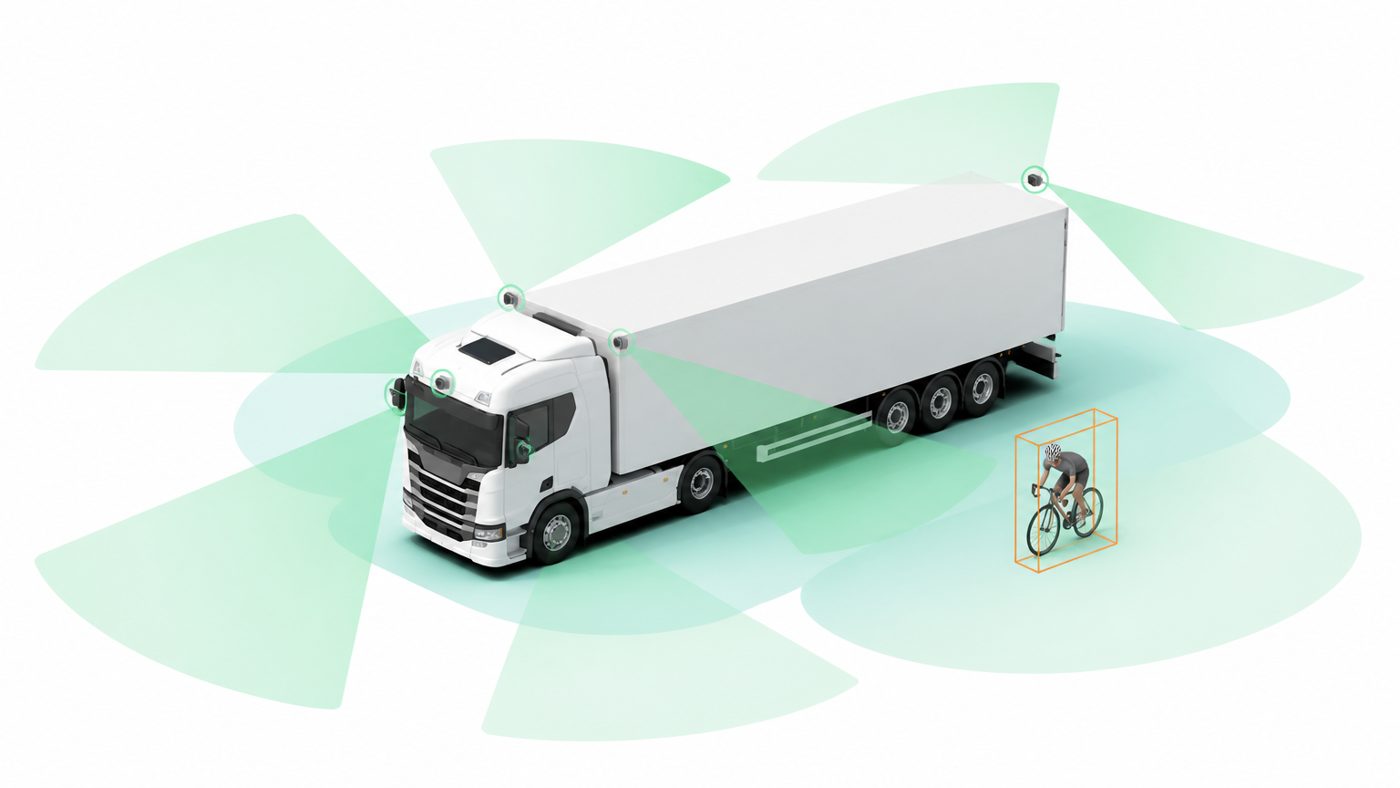
Blind spots remain one of the most persistent risks for commercial vehicles, particularly in dense urban environments. Even the most experienced drivers can miss reckless cyclists, scooters, or pedestrians.
Vision-based camera systems with kerb-detection add visibility where mirrors fall short, helping prevent the collisions that too often occur at low speeds in busy streets.
A Note on Driver & Union Resistance
A tool is only as good as its adoption. This is especially true for driver-facing camera systems, and resistance due to privacy concerns is common and understandable.
The key is to involve driver representatives early and communicate openly and fairly.
And by communicating the system's true purpose, fleets can demonstrate that it's protective rather than punitive, and by showing their role in defending drivers against false claims, suppliers can accelerate adoption and cultural change. More on this topic in Section 06.
"Success with unions means involving drivers from day one. Show that the system is there to protect, not punish."
Joe Williams, COO at Exeros
05The Role of AI in Video Telematics
Fleet managers face a paradox: they have access to more data than ever before, yet this abundance can overwhelm rather than empower. AI-powered cameras, telematics, driver apps, and maintenance systems; each produces rivers of information.
Without intelligent tools, managers risk spending hours sifting through reports, leaving little time for strategy. AI-powered video telematics offers a solution by acting as an assistant, analysing all the data and showcasing only what matters most.
The key is pattern recognition. By analysing trends across fleets, AI helps reveal the risks that are driving incidents (and ruining profit margins). This shift in focus directs limited training and coaching resources to where they will have the greatest impact.
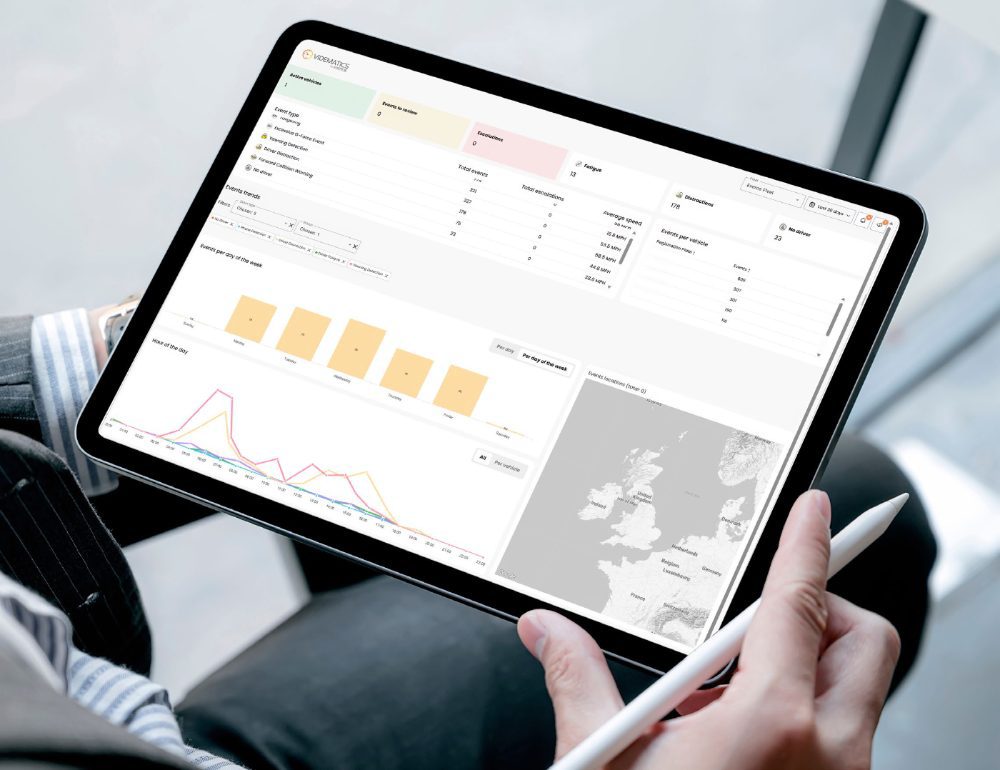
One platform for everything
Everything a fleet needs, in one place.
Every separate system is another login and another gap. Vidematics feeds your vehicles, cameras, sensors and fleet data into a single operational view.
Live and recorded HD video
Stream live or replay any trip. Pull compliance-ready clips in seconds.
AI detection and in-cab coaching
On-device AI flags fatigue, distraction, phone use and tailgating, and warns the driver in the moment.
AI event review and escalation
Filter by severity, driver or type. A review that took hours takes minutes.
Live tracking and routing
Real-time position and historical journeys with synced telemetry.
Analytics and reporting
Fatigue patterns, event hotspots and driver scoring, with reports that assemble themselves.
Privacy and compliance
UK-based, privacy-first architecture. Audit trail for DVS, FORS and CLOCS.
"Instead of drowning in data, managers see the three or four risks they need to fix today, and the actions that will make the biggest impact."
Gareth Bathers, Head of Data at Exeros
Proactive
The Three Stages of AI
AI supports the proactive element of safety by forecasting risks before they materialise. For example, predictive models can track fleet-wide patterns and then provide proactive risk assessments and advice.
Example of fleet 1
Peak fatigue around lunchtime
Example of fleet 2
Peak fatigue events during rush-hours
Secondly, there's the reactive side. For the driver, it helps identify and warn of risks in real-time. For fleet managers, AI enables smart recording, providing managers with a short clip of relevant events instead of requiring them to sift through hours of footage. Combined with AI-powered data, this enables specific incident reviews and features such as driver scoring.
Driver scoring systems provide a way to analyse and improve drivers, equipping managers with meaningful feedback on their drivers' performance.
In turn, this makes coaching conversations more constructive, helping managers move from blame to collaboration. Over time, this builds a culture where drivers feel positively towards safety measures rather than suspiciously.
"AI is powerful, but it can't do everything alone. The best results come when people and AI work together."
Gareth Bathers, Head of Data at Exeros
Driver scoring in video telematics
Meaningful feedback
Scores are tied to real events with the footage attached, not abstract metrics.
Constructive coaching
Conversations move from blame to collaboration, backed by evidence.
Smart recording
Short clips of relevant events replace hours of footage to sift through.
06Understanding Union Pushback & Privacy Concerns
Union resistance is one of the most significant barriers to the adoption of camera-based safety technology today. Concerns often centre on privacy, with drivers wary of constant monitoring or misuse of data. These concerns are not unfounded: early systems were clunky, poorly explained, and often implemented without involving drivers in the process.
That history left a legacy of distrust.
Today, the challenge is as much about perception as it is about technology. If in-cab systems are framed as surveillance, drivers will naturally resist. If they are presented as tools for support, protection, and empowerment, adoption is far smoother.
Framed as surveillance
Drivers resist
Adoption stalls, cameras get covered or disabled, and an expensive safety investment quietly stops working.
Framed as protection
Adoption is far smoother
Presented as tools for support, protection and empowerment, drivers engage rather than push back.
The reality is that many of the fears voiced by drivers and unions can be addressed directly:
However, this is not an issue fleets can solve in isolation. It's a shared challenge across the industry: suppliers, unions, regulators, and operators all have a role in building trust and reshaping perceptions.
Checklist
Steps to Overcome Union Pushback
Having a clear strategy that involves drivers is crucial to overcome fears and misconceptions around safety cameras. Below is a brief checklist that outlines the most critical steps, focusing on education, communication, and empowerment.
Exeros COO Joe Williams adds: "It's about showing your perspective. Hearing about fatigue is one thing; seeing an HGV driver on the highway with their eyes closed is something else entirely."
Adoption and union approval
The rollout drivers accept, and unions approve.
Advanced cameras only deliver if they stay switched on and drivers engage. Roadie's driver-first, privacy-first design means drivers see their own data first, improve in private, and feel protected rather than policed.
The usual driver app
Monitoring, handed to the driver
The Roadie way
Ownership, handed to the driver
What smooths union sign-off
Privacy mode as standard
Driver-facing footage is protected, access is controlled, and every review is logged.
Nothing hidden from drivers
When in Driver-Mode, drivers always know what is recorded, why, and who can see it.
Protection, not punishment
Footage clears drivers of false claims far more often than it holds them to account.
Framing the Bigger Picture
Ultimately, union pushback is not a question of 'drivers versus fleets.' It is an industry-wide challenge of education, trust, and culture. By working together (fleets, suppliers, unions, and regulators) the sector can overcome outdated perceptions and demonstrate that modern safety systems are designed not to punish or 'spy' on drivers, but to protect them.
Suppliers play a key role here. The best provider doesn't just install equipment; they work alongside fleets to educate and coach. Training sessions, workshops, and driver champions all help demonstrate that technology is about safety and assistance, not control and surveillance.
Training sessions
Delivered alongside installation, not left to the fleet to figure out.
Workshops
Open forums where drivers can ask what the system does and does not do.
Driver champions
Peer advocates who carry the message further than any policy document.

07Safety-Linked Efficiency & Cost Reduction
The difference between managing a claim with and without video evidence is not just about repair costs: it's about the cost of time, effort, and loss of revenue.
The timeline below shows how a single incident unfolds in practice: without evidence, disputes drag on for weeks and costs escalate; with clear footage, insurers can close cases quickly, claims are reduced, and vehicles return to the road much sooner.
Per-incident claims journey
Without cameras
Crash
0hr
Insurer Notified
1 hr later
Liability Disputed
1–2 weeks later
Claim Settled
45–90 days
With cameras
Crash
0hr
Insurer Receives FNOL + Video
1 hr later
Liability Confirmed
1–2 days later
Claim Settled
7–14 days
Impact per incident
£20k–£50k saved | 5–8 hrs admin saved | 30–70 days faster closure
What could this save your fleet?
Enter your vehicle mix, collision rate and insurance costs to get an estimated saving, ROI and breakeven period for your fleet.
From Cost Savings to Efficiency Gains
Beyond collisions, safety and efficiency are often portrayed as competing priorities, but in practice, they are inextricably linked. Every avoided collision prevents downtime and claim costs. Every improvement in driving behaviour reduces fuel consumption and wear.
For UK fleets, where margins are thin and fuel remains 30–40% of operating costs (FTA), this link is critical.
Unsafe driving behaviours such as harsh acceleration, speeding, and idling all increase risk while also wasting fuel. Monitoring and coaching these behaviours delivers a double return: safer roads and lower costs.
"Better driving doesn't just keep people safe, it saves on fuel and maintenance. We see this time and time again: safer fleets are more efficient."
Joe Williams, COO at Exeros
Downtime reduction is another efficiency gain. Preventive maintenance triggered by driver behaviour data can extend component life. For example, a fleet that curbs harsh braking may extend brake pad life by months across the fleet, but multiply this by dozens of vehicles, and the savings are significant.
Integration also matters. Fleets often use separate systems for telematics, safety, and maintenance. When these don't communicate, it starts to create problems. An integrated ecosystem ensures data flows smoothly, enabling managers to see the full picture: how driver behaviour affects maintenance schedules, fuel spend, and safety outcomes simultaneously.
Finally, efficiency has an environmental dimension. Reduced fuel consumption lowers emissions, helping fleets meet sustainability targets and demonstrate compliance with Clean Air Zones. For operators bidding on contracts, this can be a differentiator.
Tachographs Come to Light Vehicles
The biggest efficiency story of 2026 for light-vehicle fleets is a compliance one. From 1 July 2026, goods vehicles with a gross weight above 2.5 tonnes and up to 3.5 tonnes used for international hire and reward journeys between the UK and the EU must be fitted with a second-generation Smart Tachograph 2 and follow the same assimilated drivers' hours rules that have always applied to HGVs (DVSA, Special Notice 02-26, 2026).
Three conditions have to be met together: the vehicle or combination is over 2.5 tonnes, the work is international or cabotage, and the goods are carried for payment. Vans operating only within the UK are not required to fit a tachograph, and own-account international work where driving is not the driver's main activity stays outside scope. The strategic point still stands: the gap between a van fleet and a truck-style regulated transport operation is narrowing.
1 July 2026
Smart Tachograph 2 required on in-scope 2.5t to 3.5t vans, alongside full drivers' hours limits, breaks and rest.
88%
of the affected European fleet still needed retrofitting in May 2026, with only 27.7% of operators reporting readiness (IRU, 2026).
4 to 6 weeks
typical lead time at approved fitting centres, and workshop capacity is the bottleneck. Late bookings are the main compliance risk.
The new obligation also brings new admin. Driver card data must be downloaded at least every 28 days, vehicle unit data every 90 days, and records kept for at least 12 months. Done by hand, that is roughly half an hour per vehicle per month, with the vehicle and card physically present and the constant risk of a corrupt file that counts as non-compliant.
An Advantage rather than an Obligation
A tachograph on its own satisfies the law. Connected to a telematics platform, it pays for itself. Vidematics brings tachograph and drivers' hours data together with GPS, driver behaviour scoring, fatigue and distraction detection and video evidence, so a van fleet newly subject to HGV-style rules gets HGV-grade oversight without HGV-grade admin.
Remote download, no depot visits
Driver card and vehicle unit data are pulled over the air and archived to the legal retention schedule, removing the monthly USB round and the corrupted-file risk.
Hours monitored
Driving time, breaks and rest are visible while the shift is running, so infringements are prevented rather than discovered 28 days later at analysis.
One evidence pack
Hours records, geolocated journey legs and event footage sit in the same place for roadside checks, insurers, client audits and Traffic Commissioner reviews.
Efficiency from the same data
Accurate driving and stop times, border crossings and dwell at delivery points feed route planning, duty of care reporting and fuel work, not just compliance files.
Enforcement is already sharper than many van operators expect. DVSA fixed penalties run from £50 to £300, examiners can review the previous 28 days of records at a single stop, and serious or repeated failures put the operator licence in front of a Traffic Commissioner. For fleets crossing to the EU, remote screening means a non-compliant vehicle can be identified without ever being pulled over.
08Compliance and Legal Protection
UK fleets already face some of the strictest regulations in the world, and the pressure is growing year by year. Today's priorities include London's Direct Vision Standard (DVS) and its new Progressive Safe System, DVSA rules on roadworthiness and tachographs, and GDPR obligations on in-cab data. Many operators must also meet FORS or CLOCS to win contracts, while Clean Air Zones and the Zero Emission Vehicle (ZEV) mandate are reshaping long-term fleet investment.
Meanwhile, Europe is setting the pace with the General Safety Regulation (GSR2), mandating advanced safety features that the UK is likely to follow. The result is a rising curve of obligations: every year brings tighter rules, greater scrutiny, and higher stakes.
The timeline below shows how regulation is building, and why compliance has become one of the defining challenges in modern fleet management.
Domestic rules
DVS and the Progressive Safe System, DVSA roadworthiness and tachographs.
Contract requirements
FORS and CLOCS accreditation, increasingly a condition of winning work.
Data obligations
GDPR duties on in-cab video, retention, access control and driver rights.
Timeline of key fleet regulations
A rising curve of obligations
Looking Ahead
The regulatory landscape is shifting across Europe as well. From July 2024, the EU's General Safety Regulation (GSR2) requires all new vehicles sold in the bloc to be fitted with a suite of advanced safety systems as standard.
Intelligent Speed Assist (ISA)
Autonomous Emergency Braking (AEB)
Driver Drowsiness & Attention Warning
Emergency Lane Keeping Systems (ELKS)
Alongside improved detection systems for vulnerable road users, the aim is simple: to drastically reduce collisions, particularly those involving pedestrians, cyclists, and other vulnerable road users.
While the UK is no longer bound by EU law, history shows that British regulations often align with European frameworks over time. London's Direct Vision Standard (DVS), for example, already echoes many of the same priorities around visibility and protection.
For fleets, this means aligning with today's domestic rules and preparing for the convergence with EU standards soon.
"The EU is raising the bar on safety, and the UK will follow. Fleets that invest now will be ahead of their competitors when the new regulations arrive."
Joe Williams, COO at Exeros
AI automation: the future of fleets
Regulation sets the floor. The bigger change is what fleets do with the technology once it is fitted. Across the UK and Europe, safety is moving from manual and manager-led to automated and closed-loop: edge AI coaches the driver in the moment, scores and triages the event automatically, and escalates only the exceptions to a manager.
This is not a forecast. Automated, personalised driver coaching went live in the UK in June 2026, and the acceptance question that held it back for a decade has largely turned. The task now is designing the loop well, because a poorly tuned system fails in a predictable way: too many alerts, drivers desensitised, cameras covered up.
01
Detect on the device
Fatigue, distraction, phone use and tailgating are recognised on the camera itself, in milliseconds, with no dependence on mobile signal.
02
Nudge, then self-correct
The driver gets an audible prompt and a chance to correct before an event is ever raised with a manager. Most risk is resolved in the cab.
03
Escalate the exceptions
Events are scored for confidence and severity, so managers see the handful that need a conversation rather than the whole feed.

Automated Coaching
First-generation AI cameras created a new problem: volume. Safety managers were handed an avalanche of alerts and video, and much of it was low value. The automation now shipping is aimed squarely at that, and it works in two directions at once: fewer things reaching the manager, and better feedback reaching the driver.
On the manager's side, events are validated and scored before they are surfaced, so high-confidence incidents route straight through and weak detections are filtered out. Suppliers report removing the large majority of vehicle alerts and halving high-risk events through automated coaching workflows (vendor figures, 2026). On the driver's side, coaching has become personalised and routine rather than occasional and retrospective: weekly, event-specific feedback delivered in the driver app, targeted at the behaviours costing that individual the most.
Coaching without the diary
Automated, personalised video feedback is now live for UK fleets, with suppliers claiming coaching workloads can fall by up to 100% (vendor claim, 2026). The manager's hours move from reviewing footage to handling the few cases that need a person.
Behaviour change is measurable
A UK retail fleet using gamified real-time coaching recorded a 98% reduction in incidents of riskier driving and a 15.8% fall in blameworthy accidents, alongside £416,000 a year in fuel savings (Lightfoot and Currys, 2023).
The design rule that follows is simple: tune for a low false-positive rate and track tampering or override rates as a leading indicator. Alert fatigue is what turns a safety investment into a covered-up camera.
Three Horizons of Fleet Automation
Protect driver trust
Configurable thresholds, honest explanations, and footage used collaboratively. A third of UK drivers still worry it will be used against them.
Keep the data close
Edge processing, event triggered upload and automated masking of off-duty journeys keep UK GDPR and DPIA duties manageable.
Test the claims
Treat vendor accuracy and return-on-investment figures as claims until a pilot with your own KPIs proves them at your scale.
The fleets that get value from AI automation are the ones that let it absorb the repetitive work (detection, scoring, triage and paperwork) while keeping people in charge of coaching conversations, exceptions and decisions.
Cheat Sheet Mindset
The most effective fleets treat compliance as a continuous cycle: proactive monitoring of obligations, reactive response to inspections or incidents, and adaptive learning from breaches to prevent repeat issues.
01
Record
HD footage, FNOL video and GPS from the AI cameras. Proof of what happened, but no change in behaviour.
02
Protect
ADAS and in-cab alerts catch fatigue, distraction and tailgating in the moment. Risk falls as it happens. Most fleets need to move here first.
03
Transform
Advanced fleets upscale here. Add intelligence-led, in-app driver training targeted at the events each driver scores lowest on, turning prevention into permanent change.
Operators who adopt this mindset are not just legally protected: they're better placed to win contracts, negotiate with insurers, and demonstrate their professionalism to stakeholders.
09Choosing the Right Partner
Choosing a safety technology partner is one of the most critical decisions a fleet can make. The wrong choice leads to poor adoption, wasted investment, and frustrated drivers. The right partner, by contrast, can support compliance, reduce incidents, and deliver measurable ROI.
Here's what a modern, UK-focused partner should bring to the table:
01
Proven Solutions
Adaptable, well-supported solutions that work in real-world conditions, delivering video and data evidence fit for insurers, police, and regulators.
02
Scalable In-House Installation & UK Support
Nationwide installs by in-house engineers, depot scheduling, and enforceable SLAs covering uptime, response times, and a UK-based support centre.
03
Pilot & ROI Proof
Structured pilots with clear KPIs (incident reduction, claims costs, driver behaviour improvements) and rollout only if you see results.
04
Insurance & Claims Support
Evidence workflows designed to reduce claim frequency and cost, with direct engagement alongside brokers and insurers.
05
Compliance Fit (UK-specific)
Progressive Safe System-ready kit, understanding of FORS/CLOCS practices, and support with permits and evidence packs.
06
Integration, Not Another Silo
Open APIs and data portability to ensure safety data connects with telematics, routing, tachographs, and claims systems.
07
Data Protection & Privacy
Out-of-the-box GDPR documentation, role-based access, retention policies, and privacy features such as off-duty masking.
08
Cybersecurity & Future Readiness
ISO 27001 certification, awareness of UN vehicle cyber rules, and alignment with post-Brexit type-approval changes.
09
Change That Drivers Believe In
Union engagement, opt-in pilots, clear policies on recording, and giving drivers access to their own data to support coaching.
10
Governance & Exit Planning
Transparent data ownership, deletion SLAs, exit workflows, and financial stability checks for long-term trust.
Why This Matters
This level of detail may sound demanding, but especially for large fleets, it's essential. A true partner should be able to meet these expectations as standard, not as extras. By being specific about requirements, fleets can filter out providers who talk the talk but cannot deliver at scale.
Ultimately, partner selection is about building a long-term collaboration. The right partner grows with the fleet, ensuring safety technology continues to deliver value year after year.
10Future Trends in Fleet Safety Technology
The next five years will see another leap in safety as fleets continue to upgrade from regular telematics to modern video telematics.
Predictive prevention
Predictive analytics from video telematics will evolve into predictive prevention, forecasting not just risks but specific events.
Connected vehicles and V2X
Vehicle-to-everything communication will become a reality. A van could receive alerts from traffic lights, nearby cars, or even cyclists' devices, building a shared safety network.
AI-powered copilots
In-cab assistants providing real-time voice guidance, fatigue alerts, and even compliance reminders.
"AI co-pilots are here. Within five years, most drivers will have an assistant in the cab helping them stay safe."
Joe Williams, COO at Exeros
Regulation will continue to push adoption. Euro NCAP ratings increasingly require ADAS features, and UK insurers are likely to follow suit by offering incentives for fleets with advanced safety tech.
The fleets that prepare now, investing in flexible, scalable systems, will be best placed to adapt to these changes without disruption.
11Key Takeaways & Next Steps
The future of fleet management in the UK will be defined by safety. Not as a box-ticking exercise, but as a strategy that underpins efficiency, compliance, and long-term success.
The most resilient fleets adopt a cycle of safety, incorporating proactive measures to prevent incidents, reactive capabilities to respond effectively when they occur, and adaptive learning to improve continually.
Exeros helps fleets achieve precisely that. Whether it's preventing collisions with fatigue detection, empowering drivers with video telematics, or using AI to predict and mitigate risks, our solutions are designed to support operators at every stage of the journey.
To explore how these approaches could work in your fleet, our specialists can provide tailored advice.

About us
About Exeros Technologies
Exeros Technologies is a safety partner for fleets, reducing risk and protecting drivers through video telematics, smart cameras, and expert support.
With 15+ years of experience, we tackle challenges across every industry, from fatigue and distraction to bridge strikes, visibility issues, and other complex problems.
We use quality solutions, in-house engineers, and UK-based support to ensure our solutions work on paper and in the real world.
Every. Single. Day.
References