Why Driver Monitoring Systems Miss Early Warnings
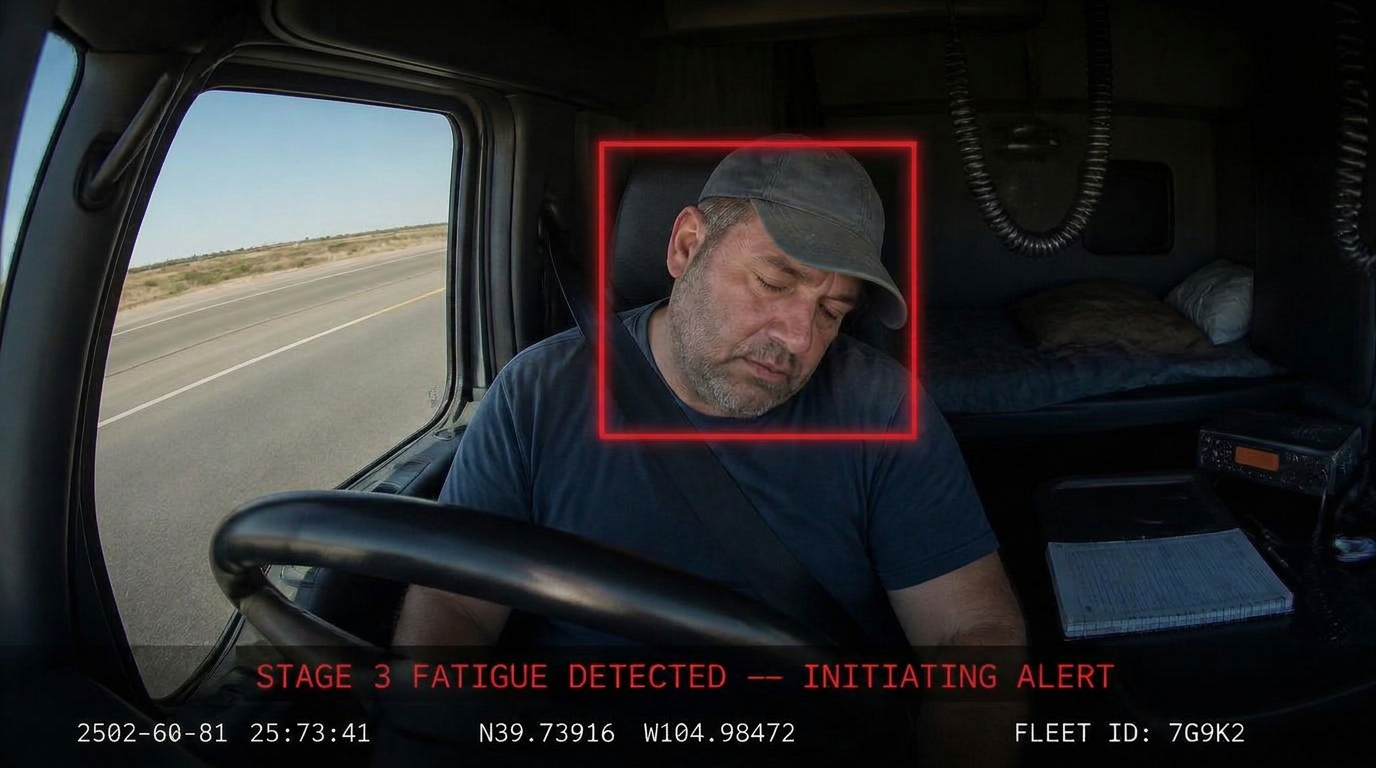
Most driver monitoring systems are working exactly as designed when they miss the early signs of fatigue. A camera trained on a driver's eyes will faithfully report closed eyes and a drooping head, but it won't tell you anything about the two or three hours of build-up that came before, because most systems were never built to look for that. For a fleet manager relying on a single in-cab camera and a threshold-based alert, the warning tends to arrive at the same moment as the risk, not ahead of it.
That's a problem in any vehicle. In a commercial fleet running multiple drivers across long shifts, varied routes and unpredictable schedules, it's a problem that compounds fast: in cost, in liability and in lives. This is the first post in a short series on closing that gap, so we start with where it comes from.
What Driver Monitoring Systems Watch For
Commercially available driver monitoring systems, or DMS, typically rely on a camera pointed at the driver's face, usually paired with infrared illumination so it keeps working after dark. The camera tracks a small set of physical cues: how far the eyes close, how long they stay closed, blink rate, head angle and sometimes yawning.
The most common measurement behind this is PERCLOS, short for percentage of eyelid closure. It calculates what proportion of a rolling time window the driver's eyes have spent mostly or fully closed. When that proportion crosses a set threshold, the system fires an alert: a beep, a vibration in the seat, a spoken warning.
It's a genuinely useful piece of engineering, and it does what it's designed to do reasonably well. The issue isn't accuracy in the narrow sense. A well-calibrated camera can measure eye closure correctly. The issue is what that measurement actually captures. PERCLOS and similar metrics detect fatigue once it's already visible on the driver's face. By the time eyelids are closing for a meaningful percentage of any given window, the driver has typically been fighting tiredness for a while already. The system isn't wrong, it's just late by design.
Where the Early Warning Gets Lost
Standalone DMS hardware misses the early stages of fatigue for a handful of specific, well-documented reasons.
It's built to catch a threshold, not a trend. An alert fires once eye closure crosses a fixed percentage over a fixed time window. Below that threshold, the system has nothing to say, even if a driver's blink rate has been climbing steadily for the last ninety minutes, which is, in itself, a meaningful signal. Trend data mostly gets discarded in a threshold-based system, because the only question it's asking is whether the line has been crossed yet.
Cameras have real environmental blind spots. Infrared helps with darkness, but dawn and dusk driving, exactly the hours when a lot of trunk and delivery work happens, sit in an awkward middle ground of low, changing light that many systems handle poorly. Sunglasses, low head angles and glare off a wet windscreen can all degrade a camera's read on the driver's eyes.
The system doesn't know anything about the shift. A camera watching a driver's face has no idea whether that driver clocked on nine hours ago or nine minutes ago, or whether they had a broken night's sleep before coming in. Fatigue risk isn't just physiological, it's contextual, and none of that context reaches a camera-only system.
The alert usually stops at the windscreen. Even when detection works exactly as intended, the warning is often heard by exactly one person, the driver, at the moment they're least equipped to judge their own state. If the alert doesn't reach a controller, dispatcher or safety manager who can act independently of the driver's own judgement, it isn't really a fleet safety system. It's a personal alarm clock.
Vision is one signal among several, and often not the first to move. Fatigue tends to show up in how a vehicle is driven, through small increases in lane drift or inconsistent following distance, before it shows up plainly on a driver's face. A system that only watches the face is, by definition, ignoring signals that frequently arrive earlier.
What This Means for Your Fleet
None of this is a reason to distrust fatigue detection technology. It's a reason to be precise about what it can and can't see on its own, and why the fix isn't a better camera so much as a wider view.
It's part of why RoSPA has called for a standardised roadside fatigue test, similar to a breathalyser: the tools available today, in a vehicle or at the roadside, still don't reliably catch fatigue early enough on their own.
The next post in this series, The Real Cost of Driver Fatigue in UK Commercial Fleets, looks at what fleets specifically stand to lose from that gap, using DfT and RoSPA figures. After that, we cover how telematics integration closes it, and what to look for in DMS hardware before you buy.
If you want a look at how our AI fatigue detection works alongside a wider video telematics platform, rather than as a standalone camera, you can see it there.
Or if you'd rather talk it through first, get in touch and we'll walk you through it on your own fleet.
Frequently Asked Questions
What is driver fatigue detection?
Driver fatigue detection uses in-cab cameras and sensors to monitor physical signs of drowsiness, typically eye closure, blink rate and head position, and alert the driver in real time. Most systems use a method called PERCLOS to measure what percentage of time the eyes are closed beyond a set threshold.
Why do driver monitoring systems miss early signs of fatigue?
Standalone DMS hardware is built to detect fatigue once it's visible on the driver's face, not the build-up beforehand. It typically has no data on shift length, time of day or driving history, and can be affected by low light, sunglasses or camera angle, all of which delay or degrade detection.

Read more from Exeros


Talk to our team about your fleet's specific challenges and how we solve them.